For freelancers and consultants
Contract review for freelancers and consultants
Clients send contracts their lawyers wrote to protect them. LegalSling makes freelance contract review straightforward: it explains every clause in plain English and flags the terms that tilt the deal, before you sign.
What is freelance contract review?
Freelance contract review means reading a client’s contract before you sign it, to see what you’re agreeing to: who owns the work, when you’ll be paid, what you’d owe if something went wrong, and what you can’t do afterwards. LegalSling is built for freelancers, contractors and independent consultants in the UK, EU and US who are sent client contracts, consultant agreements and statements of work by bigger organisations.
Know what matters, and what to ask
Client contract terms are drafted to protect the client, and often arrive with a start date already agreed. Paying a lawyer to read every one rarely makes sense on a freelance fee, so it’s tempting to sign and hope.
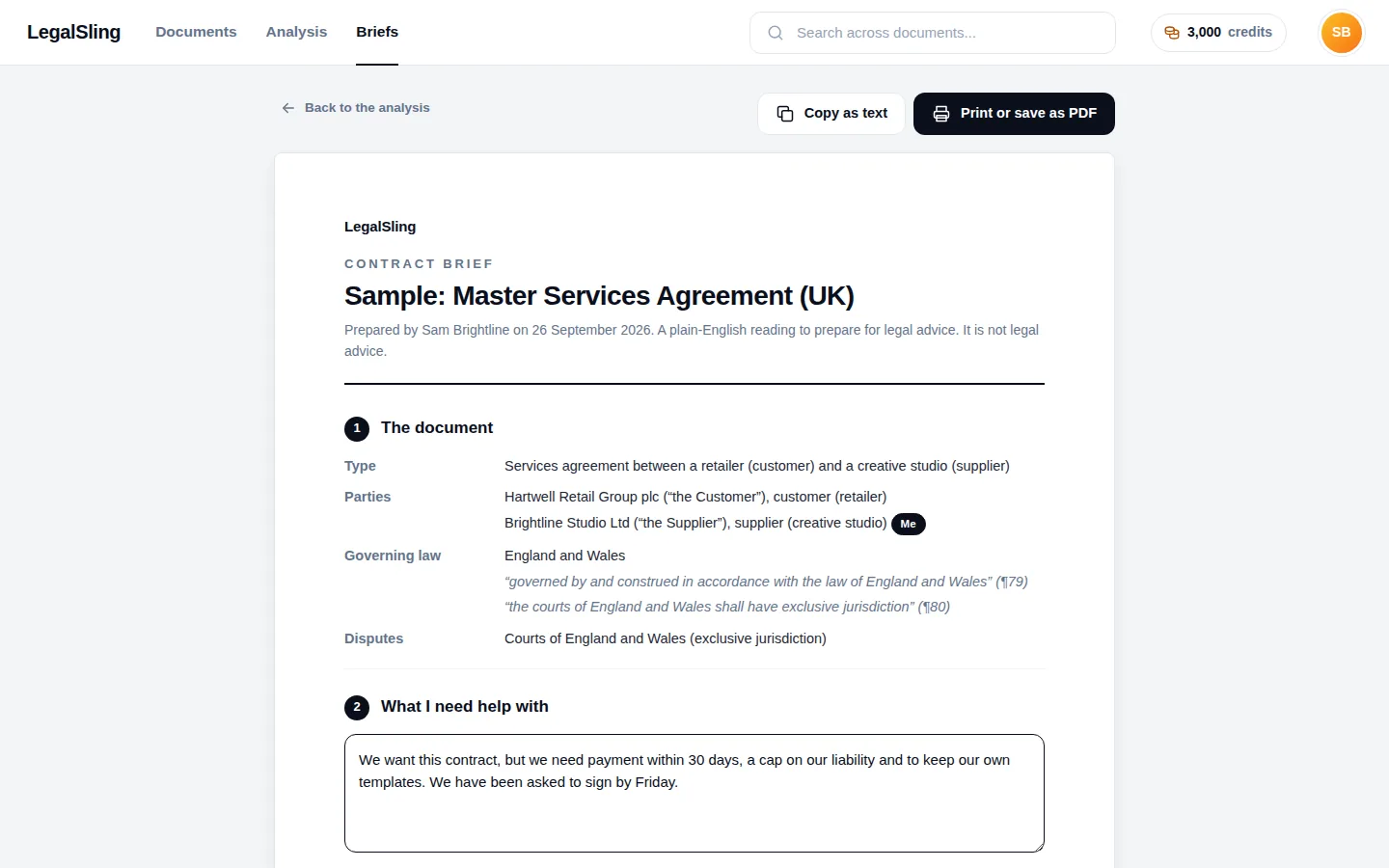
LegalSling explains each clause and flags the ones that go further than usual. Add notes on what matters to you, such as keeping your templates or being paid within 30 days, and it turns them into a brief for a lawyer when you need one.
The contracts freelancers and consultants are sent
Most freelance work runs on one of a handful of documents, usually drafted by the client. Here’s what each one covers and where it tends to lean.
Client service agreements and statements of work
Larger clients often pair a master agreement with a statement of work (SOW) for each project. Watch for vague scope and unlimited revisions, and check which document wins if they conflict.
Consultancy agreements
These can ask for warranties about results you don’t control, professional indemnity insurance (errors and omissions cover in the US) above what you carry, and uncapped liability.
Independent contractor agreements (US)
US agreements often call your work “work made for hire” and add an assignment as a backup in case it doesn’t qualify. Some add a non-compete, and state rules on those vary.
Non-disclosure agreements
Often sent before a first call or pitch. Check whether the NDA is mutual, how widely it defines confidential information, how long it lasts, and whether it also includes a non-solicit.
Platform and agency terms
Platforms and agencies that place you with clients have terms of their own. They often restrict working directly with a client they introduced, or charge a fee if you do.
Employment status and IR35 clauses (UK)
UK contracts may include clauses about your employment status or IR35, the off-payroll working rules. LegalSling explains what such a clause says. Questions about your tax status are for an accountant or tax adviser.
Freelancer contract red flags to check first
The clauses that most often go against freelancers decide who owns the work, how and when you’re paid, what you’d owe if something went wrong, and what you can’t do afterwards. These guides explain each one.
How LegalSling helps freelancers and consultants
LegalSling works as a freelance contract checker that explains everything it flags. Upload the contract as a PDF (scans included), a Word document or text, and you get:
- Every clause explained in plain English, with what it means for you and for the client, and which way it leans.
- Red flags for terms that are markedly one-sided, unusual for this kind of agreement or may go further than the law allows, plus points worth a look, with the exact words highlighted.
- The governing law, taken from the contract’s own wording and quoted, or “not stated” if it isn’t there. It’s built for England and Wales, Scotland, Northern Ireland, EU member states and US states.
- Answers to questions such as “Can I reuse my own templates after this project?”, drawn only from the contract, with paragraph references.
- Your own notes, gathered with the flags and suggested questions into a printable brief for a lawyer.
- Every quote it shows checked against the contract’s actual text.
New accounts get free credits to try it. See pricing.
What LegalSling isn’t
LegalSling isn’t a law firm and doesn’t give legal advice. It explains what a contract says and flags points to raise, but it won’t tell you whether to sign or what to negotiate. For a valuable, long-term or risky contract, a lawyer’s advice is worth having, and the brief means you pay for their judgement, not their first read. See how to brief a lawyer on a contract.
Frequently asked questions
What should I check in a freelance contract before I sign it?
Start with the money: your rate, when you can invoice, how long the client has to pay and what it can deduct. Then check who owns the work (including tools you already had), what you’d owe if something went wrong, how each side can end the contract, and any restrictions once the project ends. Our contract red flags checklist covers each one.
Who owns the work I create for a client?
It depends on the contract and the law that governs it. In the UK, under the Copyright, Designs and Patents Act 1988, a freelancer usually owns the copyright in their work unless it’s assigned in writing. Under US copyright law, a contractor’s work generally only counts as “work made for hire” in certain categories and with a signed written agreement. Client contracts often include an assignment, so check what it covers.
Is a non-compete in a freelance contract enforceable?
It depends on where you are and how wide it is. In the UK, courts generally enforce a restriction only if it protects a legitimate business interest and goes no further than reasonably necessary. EU countries have their own rules, and US rules vary by state: California, for example, treats most non-competes as void. Whether a particular clause would hold is a question for a lawyer.
Does LegalSling work for US independent contractor agreements?
Yes. It’s built for contracts under the law of US states, as well as the UK and EU member states. It takes the governing law from the contract’s own wording and shows you the quote, or says “not stated” rather than guessing. Rules differ from state to state, so check anything important with an attorney.
Can LegalSling tell me whether to sign?
No. It explains what each clause says, what it means for you and for the client, and where the contract is one-sided or unusual, but it doesn’t give legal advice or tell you whether to sign. That’s your decision. When a clause matters, the brief gives a lawyer the flags, your notes and your questions, so advice is quicker to get.
Know what you’re signing
Upload a contract and get a plain-English review with red flags and a brief for your lawyer. 3,000 free credits to start, no card needed.