For agencies and studios
Contract review for agencies and studios
Big clients send master services agreements written to protect them. LegalSling does the first pass of agency contract review: it explains every clause in plain English and flags the terms that put too much of the risk on your agency.
Agency contract review without an in-house lawyer
Agency contract review means checking a client’s master services agreement (MSA), statement of work or procurement terms before you sign, to see how much risk you’re taking on for the fee. LegalSling is built for creative, digital, marketing and PR agencies and studios in the UK, EU and US that work for bigger organisations, whether it’s a creative agency contract for a campaign or a marketing agency contract on retainer.
The whole agreement, summarised and explained
Agencies often hand client contracts to an account director, an ops lead or a founder, with no lawyer on staff and a start date already agreed. The terms were written for the client’s whole supply chain, and don’t always fit the size of the job.
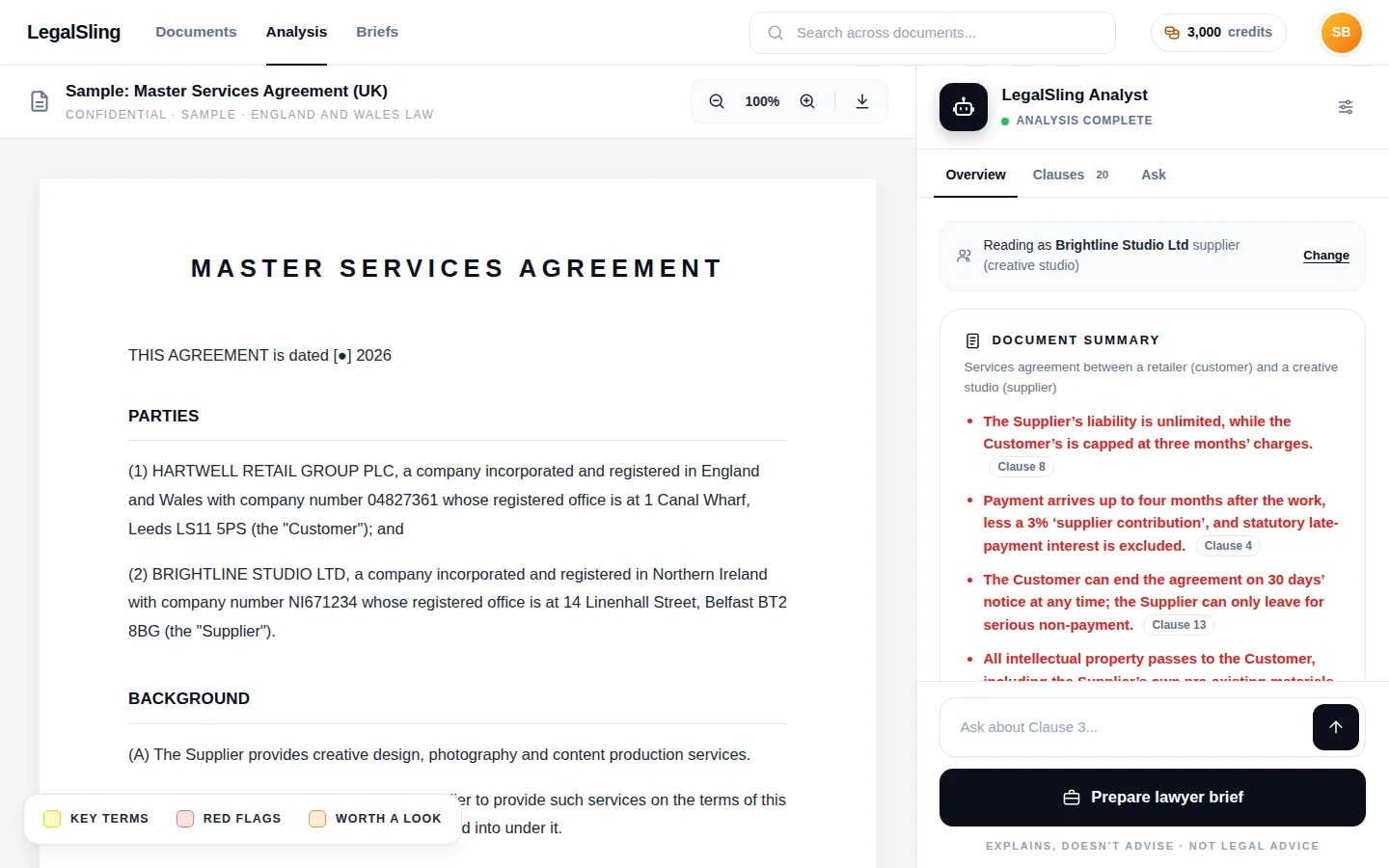
LegalSling summarises the agreement and its main red flags, each tied to the clause it comes from, then explains every clause in plain English, with what it means for your agency and for the client.
What contracts do agencies and studios sign?
Most agency work runs on a stack of documents: a client MSA, a statement of work for each project, and sometimes procurement terms on top. Here’s where each one tends to lean.
Master services agreements (MSAs)
The MSA sets the legal terms for every project: liability, IP, payment, confidentiality and termination. It may ask for insurance above your cover, or stop you hiring the client’s staff without stopping them hiring yours.
Statements of work
Each SOW sets the scope, deliverables, timings and fees. Watch for vague scope and acceptance left to the client’s discretion, and check which document wins if the SOW and the MSA conflict.
Procurement and framework terms
Large clients may put you on standard terms written for all their suppliers. Look for long payment terms, rebates and other deductions, audit rights, and data protection terms, which UK and EU law require if you process personal data on the client’s behalf.
Subcontractor and freelancer agreements
These go the other way: you send them. If what you promise the client on IP, confidentiality and data doesn’t flow down to your freelancers and subcontractors, the gap is yours.
Non-disclosure agreements
Often signed before a pitch. Check whether the NDA is mutual, so that what you share in a pitch is protected too, and how long it lasts.
Retainers
A regular fee for ongoing work. Check what the fee covers, what happens to unused hours, the notice period, and whether the retainer renews automatically.
Client MSA red flags: the clauses to check
In a client’s MSA, the imbalance usually sits in four places: liability, indemnities, intellectual property and termination. These guides explain each one.
How LegalSling helps agencies and studios
Whether it’s a master services agreement review for a new account or a quick check of an SOW, LegalSling gives whoever holds the contract a clear reading before it goes back to the client. Upload it as a PDF (scans included), a Word document or text, and you get:
- Every clause explained in plain English, with what it means for your agency and for the client, and which way it leans.
- Red flags for terms that are markedly one-sided, unusual for this kind of agreement or may go further than the law allows, plus points worth a look, with the exact words highlighted.
- The governing law, taken from the contract’s own wording and quoted, or “not stated” if it isn’t there. It’s built for England and Wales, Scotland, Northern Ireland, EU member states and US states.
- Answers to questions such as “What are we paid if the client terminates mid-project?”, drawn only from the contract, with paragraph references.
- Your own notes, gathered with the flags and suggested questions into a printable brief, so a lawyer can advise quickly on the clauses that matter.
- Every quote it shows checked against the contract’s actual text.
New accounts get free credits to try it. See pricing, or read how uploaded contracts are protected.
What LegalSling isn’t
LegalSling isn’t a law firm and doesn’t give legal advice. It explains what the client’s contract says and flags points to discuss, but it won’t tell you whether to sign or what to negotiate. For high-value or high-risk work, a lawyer’s advice is worth having, and the brief lets them focus on the clauses that matter. See how to brief a lawyer on a contract.
Frequently asked questions
What should an agency check in a client’s master services agreement?
Start with liability and indemnities, and compare the most you could owe with the fees you’ll earn. Then check who owns the work (including pitch ideas and your existing assets), payment terms and deductions, how the client can end the agreement and what you’re paid if it does, and any audit, data protection or staff non-solicitation obligations.
What’s the difference between an MSA and a statement of work?
A master services agreement sets the legal terms for the whole relationship, such as liability, IP, payment and termination. A statement of work sits under it and describes one project: scope, deliverables, timings and fees. Many MSAs say which document wins if the two conflict, often the MSA, so it’s worth checking both before you rely on anything in the SOW.
Who owns the intellectual property in agency work?
It depends on who created it and what the contracts say. In the UK, under the Copyright, Designs and Patents Act 1988, work your employees create in the course of their jobs generally belongs to the agency, while freelancers usually own the copyright in their work unless they assign it in writing. If your MSA assigns everything to the client, check that your freelancer agreements give you those rights.
Can a client end the contract part-way through a project?
If the MSA or statement of work gives the client a right to terminate for convenience, it can generally do so on the notice the clause sets. What matters then is what you’re paid for work done, work in progress and costs you’ve committed to, such as freelancers or media bookings. See our guide to termination clauses.
Do we need a lawyer to review every client contract?
Not every statement of work or renewal justifies a lawyer’s fee, but for high-value, long-term or high-risk agreements, advice is worth having. Understanding the contract first keeps that advice quick: take the clauses that worry you, often liability, indemnities and IP, to a lawyer with specific questions. LegalSling’s brief is designed for that handover.
Know what you’re signing
Upload a contract and get a plain-English review with red flags and a brief for your lawyer. 3,000 free credits to start, no card needed.